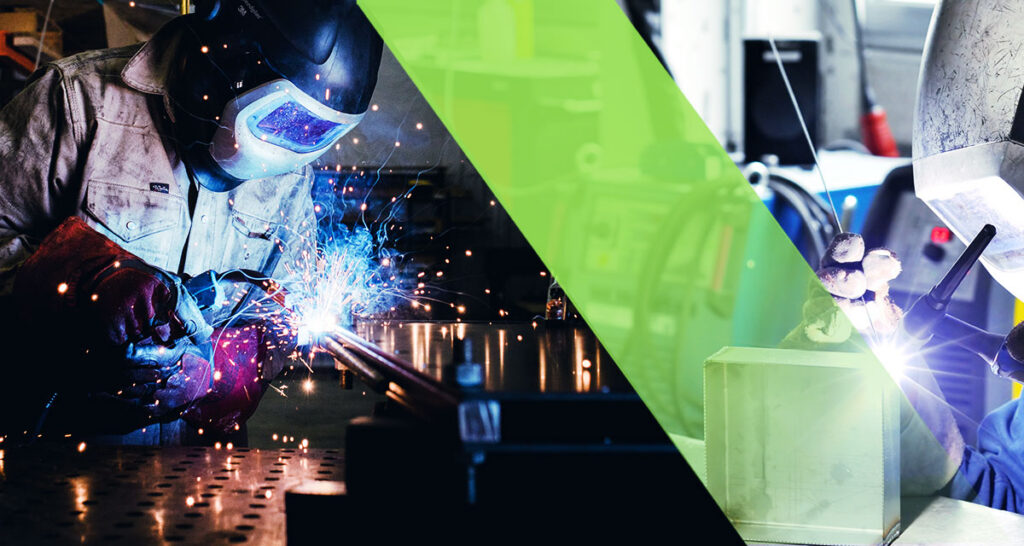
MIG vs. TIG welding comes down to differences in speed, control, technique, equipment, and the type of project being welded. MIG welding uses a continuously fed wire electrode and is often faster and easier for beginners to learn. TIG welding uses a nonconsumable tungsten electrode and gives the welder greater control, making it well suited for precise, clean welds and thinner materials.
Both processes are widely used. Neither is automatically better than the other.
The right process depends on the metal, material thickness, desired finish, production needs, and the skill of the welder.
What Is MIG Welding?
MIG stands for metal inert gas. The process is commonly known in the welding industry as Gas Metal Arc Welding, or GMAW.
According to the American Welding Society (AWS), GMAW uses a continuously fed wire electrode and shielding gas to join metals.
The wire serves as both the electrode and filler material. When the welder pulls the trigger on the welding gun, wire feeds through the gun while an electric arc generates the heat needed to melt and join the metal.
Shielding gas helps protect the molten weld pool from gases in the surrounding atmosphere.
Because the wire feeds continuously, MIG welding can be relatively fast and efficient. The process is used across industries including automotive, manufacturing, construction, energy, and fabrication.
What Is TIG Welding?
TIG stands for tungsten inert gas. Its industry name is Gas Tungsten Arc Welding, or GTAW.
Instead of using a consumable wire electrode, TIG welding creates an arc using a nonconsumable tungsten electrode.
When filler metal is needed, it is typically added separately by the welder.
That difference is important.
With TIG, the welder may need to control the torch with one hand while adding filler material with the other. Some applications also involve controlling amperage with a foot pedal.
That requires coordination, patience, and practice.
The tradeoff is control. TIG allows a skilled welder to carefully manage heat input, the weld puddle, and bead shape. It is frequently used when weld quality, appearance, or precision is especially important.
MIG vs. TIG Welding: What Is the Difference?
The biggest difference between MIG vs. TIG welding is how the electrode and filler metal are used.
MIG feeds a consumable wire electrode continuously through the welding gun. TIG uses a tungsten electrode that does not become the filler material. When filler is needed during TIG welding, it is added separately.
That fundamental difference affects nearly everything else about the processes.
MIG Welding
- Uses a continuously fed wire electrode
- Generally allows faster welding speeds
- Can be easier for beginners to learn
- Works well for many production and fabrication applications
- Can be used on a variety of metals and thicknesses
TIG Welding
- Uses a nonconsumable tungsten electrode
- Filler metal can be added separately when needed
- Offers precise control over heat and the weld puddle
- Often requires more hand-eye coordination
- Can produce clean, visually precise welds
Both methods require proper setup, technique, safety procedures, and an understanding of the material being welded.
Is MIG or TIG Easier to Learn?
MIG is generally considered easier for beginners to start learning.
One reason is the continuous wire feed. Once the machine is properly set up, the welder can focus on maintaining the correct gun angle, travel speed, distance, and position while the machine supplies the wire.
TIG adds additional coordination.
A TIG welder may simultaneously control the torch, filler rod, weld puddle, and heat input. Small changes in movement can affect the finished weld.
That does not mean MIG welding requires little skill.
Producing strong, consistent welds requires practice with either process. As projects become more complex, welders also need to understand factors such as joint design, material preparation, welding positions, machine settings, and how different metals react to heat.
Which Is Faster: MIG or TIG Welding?
MIG is generally the faster process.
The continuously fed electrode allows welders to deposit filler metal efficiently without adding a separate filler rod.
That can make GMAW useful in environments where productivity and welding speed matter.
TIG is typically slower because the process emphasizes control. The welder must manually add filler material while carefully managing the arc and heat.
Faster, however, does not always mean better.
For some jobs, production speed is the priority. For others, control, appearance, or the characteristics of the material may be more important.
Professional welders need to understand when each approach makes sense.
Which Produces Cleaner Welds?
TIG is well known for producing clean, precise welds when performed correctly.
The process gives the welder fine control over heat, filler material, and bead placement. It also produces no slag from flux, which can contribute to a clean finished appearance.
That is one reason TIG is used for applications where appearance and precision matter.
MIG can also produce high-quality welds.
The final result with either process depends on much more than the machine. Material preparation, machine settings, shielding gas, electrode selection, travel speed, technique, and welder experience all play a role.
A poorly executed TIG weld is not automatically better than a properly executed MIG weld.
What Metals Can MIG and TIG Weld?
Both processes can be used with several metals.
MIG welding is commonly used on materials such as carbon steel, stainless steel, and aluminum. The specific wire, shielding gas, machine setup, and technique must match the material.
TIG is also used with carbon steel, stainless steel, and aluminum, along with other metals and alloys.
AWS notes that TIG is especially useful for thin sections and nonferrous alloys because of the level of heat control the process can provide.
Aluminum is a good example of why knowing more than one welding process matters. Both MIG and TIG can be used to weld aluminum, but the equipment, preparation, settings, and techniques differ.
There is no single welding process that is best for every metal or every job.
MIG vs. TIG Welding: Which Is Better?
When comparing MIG vs. TIG welding, the better question is not necessarily, “Which one is best?”
Ask, “Which one is better for this job?”
MIG may be preferred when speed, efficiency, and higher production rates are important.
TIG may be preferred when the project requires greater control, precision, or work on thin or sensitive materials.
The choice can also depend on:
- Base metal
- Material thickness
- Joint design
- Required weld quality
- Desired appearance
- Welding position
- Production speed
- Equipment available
- Welder skill
This is why professional welding involves much more than learning how to operate one type of welding machine.
Why Welders Learn Multiple Welding Processes
A welder will encounter very different projects throughout a career.
One day could involve structural steel. Another project could involve pipe, automotive components, manufacturing equipment, or custom metal fabrication.
Different jobs can require different processes.
Beyond MIG and TIG, welders may also work with Shielded Metal Arc Welding, commonly called Stick welding, and Flux Cored Arc Welding.
Learning multiple processes helps a welder understand how welding changes based on the material, environment, joint, equipment, and requirements of the project.
It also develops a broader technical foundation.
That is where hands-on training becomes important.
Reading about the difference between MIG and TIG can help you understand how each process works. Developing the physical skills to create consistent welds requires practice.
Learn MIG and TIG Welding at J-Tech
If researching MIG vs. TIG welding has made you curious about learning the processes yourself, welding training can provide the opportunity to develop those skills through hands-on practice.
Jones Technical Institute (J-Tech) offers a Welding & Fabrication Technology program at its Jacksonville, Florida campus.
Students train with equipment used for TIG, MIG, Stick, and flux-cored welding. The program also includes instruction in fundamentals of welding, structural welding, GMAW, advanced GMAW, flux cored arc welding, GTAW, pipe welding, advanced GTAW, fabrication, and other areas.
J-Tech’s welding students train in a 6,400-square-foot Welding & Fabrication workshop designed to provide hands-on experience with welding tools and equipment.
The Welding & Fabrication Technology program can be completed while a student works.
Students also receive career and job placement assistance. Employment is not guaranteed.
For someone who enjoys working with their hands, solving problems, and seeing a finished product take shape, welding and fabrication may be worth exploring.
Frequently Asked Questions
What is the main difference between MIG and TIG welding?
MIG uses a continuously fed consumable wire that is delivered from a spool through the torch lead and forms the electrode in the welding torch. TIG uses a nonconsumable tungsten electrode, with filler metal added separately when needed. MIG generally emphasizes speed and efficiency, while TIG provides greater control and precision.
Is MIG or TIG better for beginners?
MIG is often easier for beginners to start learning because the wire feeds automatically through the welding torch. TIG typically requires more coordination because the welder may control the torch, filler material, and heat at the same time.
Is MIG welding faster than TIG welding?
Generally, yes. MIG welding’s continuous wire feed allows filler metal to be deposited efficiently, making it useful for many production applications. TIG is usually slower because the welder has greater manual control over the process.
Can MIG and TIG both weld aluminum?
Yes. Both MIG and TIG can be used for aluminum. Each process requires the correct equipment, settings, shielding gas, preparation, and technique for the material and application.
Does TIG welding look better than MIG welding?
TIG is known for producing clean and precise weld beads when performed correctly. However, weld appearance depends on the welder’s skill, material preparation, settings, and technique. Both processes can produce quality welds when used properly.
Do professional welders need to know MIG and TIG?
The processes a welder needs depend on the employer, industry, and type of work. Learning multiple welding processes can help students build a broader skill set and understand which process is appropriate for different applications.
Can I learn MIG and TIG welding at J-Tech?
Yes. J-Tech’s Welding & Fabrication Technology program in Jacksonville includes training in GMAW, commonly called MIG, and GTAW, commonly called TIG. Students also receive training in additional welding and fabrication processes through hands-on classroom and laboratory instruction.