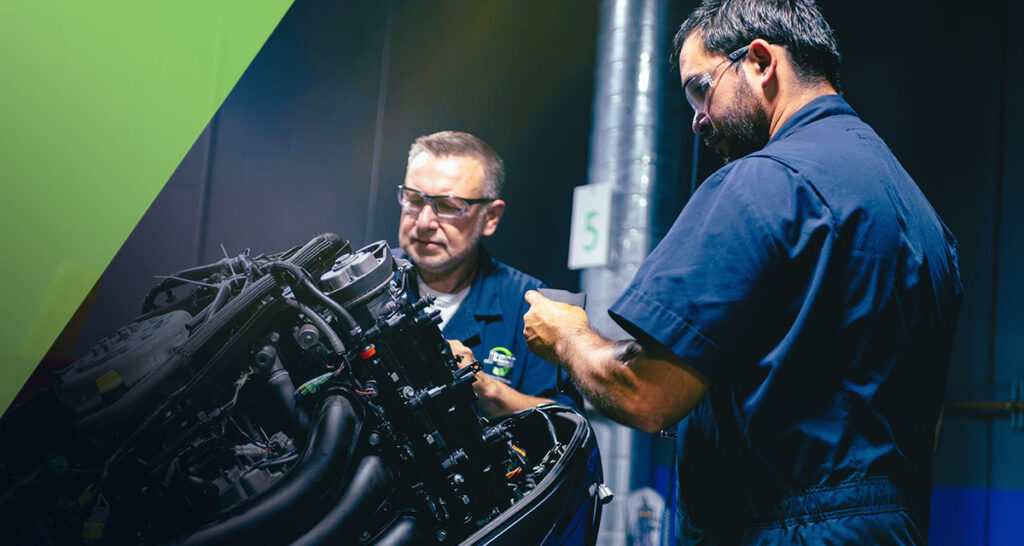
Inboard vs. outboard motors differ primarily in engine placement, propulsion, maintenance, and performance. Inboard engines are installed inside a boat’s hull and typically power a propeller through a drive shaft. Outboard motors are mounted externally at the stern and combine the engine, gearbox, and propeller into one unit. Both can deliver reliable performance, but the better choice depends on the boat and how it will be used.
Understanding these differences is useful for boat owners, buyers, and anyone interested in how marine engines operate.
What Is an Inboard Motor?
An inboard motor is an engine installed inside a boat’s hull. Traditional inboard systems transfer power through the transmission and propeller shaft, while a separate rudder controls steering.
Inboard engines can run on gasoline or diesel fuel. They are commonly found in larger recreational vessels, cruising boats, and specialized watersports boats.
Because the engine sits inside the hull, its weight can be positioned lower and closer to the boat’s center.
This arrangement can benefit weight distribution and leave the stern available for swimming platforms or other features.
However, inboard engines require dedicated space inside the boat. Accessing certain components can also be challenging, depending on the engine compartment.
What Is an Outboard Motor?
An outboard motor is a self-contained propulsion system mounted on the outside of a boat’s transom.
The unit typically includes the engine, gearbox, propeller, and steering components.
Unlike a traditional inboard system, an outboard steers by turning the motor and its lower unit. Many outboards can also tilt upward, helping protect the propeller in shallow water or when the boat is stored.
Outboard motors are common on fishing boats, pontoons, center-console boats, and smaller recreational vessels.
Modern outboards range from small portable engines to powerful systems used on larger boats.
Their external placement also leaves more usable space inside the hull.
Inboard vs. Outboard Motors: Key Differences
The most important differences involve engine location, steering, maintenance access, and typical applications.
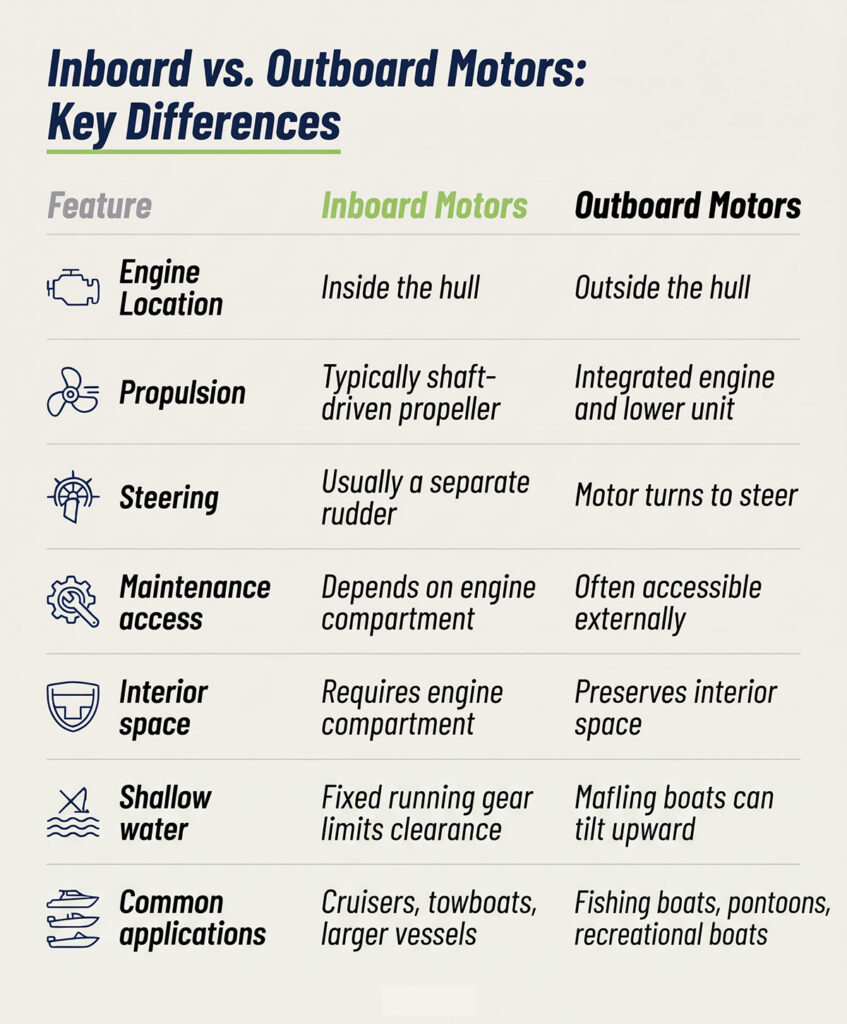
Neither design is automatically superior.
Each offers advantages depending on the boat’s size, intended use, and operating conditions.
Which Motor Offers Better Performance?
Performance depends on more than whether an engine is mounted inside or outside the boat.
Horsepower, torque, hull design, weight, propeller selection, and operating conditions all affect how a boat performs.
Inboard Motor Performance
Inboard engines are commonly used where consistent power delivery and specialized handling characteristics matter.
For example, many watersports boats use inboard propulsion because it supports the design and performance requirements of skiing and wakeboarding.
Inboards can also be well suited to larger vessels designed for cruising or extended operation.
Outboard Motor Performance
Outboards are available in a wide range of horsepower ratings.
Their steerable lower units provide responsive maneuvering, while adjustable trim allows operators to change the motor’s angle for different conditions.
Multiple outboards can also be installed on larger boats to provide substantial combined power.
Ultimately, the best performance comes from matching the propulsion system to the vessel.
Are Inboard or Outboard Motors Easier to Maintain?
Maintenance is one of the biggest considerations when comparing inboard vs. outboard motors.
Both require regular inspections, fluid changes, cooling system maintenance, and attention to corrosion.
However, the work involved can differ.
Outboard Maintenance
Outboards are mounted externally, making many components accessible without entering a confined engine compartment.
Common maintenance tasks include:
- Engine oil changes on four-stroke models
- Gearcase lubricant replacement
- Fuel system inspections
- Water pump and cooling system checks
- Propeller inspections
- Corrosion protection
Because outboards are exposed to the elements, proper cleaning and corrosion prevention are especially important.
Inboard Maintenance
Inboard systems may require servicing additional components associated with their installation and propulsion design.
Maintenance can include:
- Engine oil and filter changes
- Cooling system inspections
- Fuel system maintenance
- Drive shaft and coupling inspections
- Exhaust system checks
- Transmission servicing
Engine compartment accessibility can affect the difficulty of repairs.
Regardless of the system, following the manufacturer’s recommended maintenance schedule is essential.
Which Motor Is More Fuel Efficient?
There is no universal winner.
Fuel efficiency depends on engine technology, horsepower, boat weight, hull design, propeller selection, speed, and operating conditions.
Modern outboards often use electronic fuel injection and other technologies designed to improve efficiency.
Inboard engines can also provide efficient operation when properly matched to the vessel.
Comparing two engines based only on their mounting location does not provide an accurate picture.
For a meaningful comparison, boat owners should examine fuel consumption data for the specific engines and boats they are considering.
What About Inboard/Outboard Motors?
There is a third propulsion system worth understanding.
An inboard/outboard motor, commonly called a sterndrive or I/O, combines features of both designs.
The engine sits inside the hull, while an external drive unit transfers power to the propeller.
Unlike a traditional shaft-driven inboard, the sterndrive unit turns to steer and can be trimmed.
Sterndrives are commonly used on recreational runabouts, cruisers, and certain watersports boats.
They offer an alternative for boat owners who want an internally mounted engine with a steerable external drive.
However, sterndrives also have their own maintenance requirements, including care for the external drive and its associated components.
Inboard vs. Outboard Motors: Which Is Better?
The right choice depends on how the boat will be used.
An outboard may be preferable if you want:
- More usable interior space
- Accessible engine components
- Adjustable trim and tilt
- A propulsion system suited to many fishing and recreational boats
An inboard may be preferable if you want:
- An engine installed inside the hull
- A propulsion system designed for specialized watersports
- A configuration suited to certain larger vessels
- A stern layout without an externally mounted engine
When comparing inboard vs. outboard motors, consider the complete boat rather than focusing only on the engine.
The hull, propulsion system, maintenance requirements, and intended activities should work together.
Why Marine Technicians Need to Understand Both
Understanding how different marine engines work is important for anyone considering a career in marine technology.
Marine technicians may encounter gasoline engines, diesel engines, electrical systems, propulsion components, and specialized diagnostic equipment.
An outboard engine requires different service procedures than an inboard system.
Technicians must understand how components interact, recognize mechanical problems, and follow appropriate repair procedures.
For example, diagnosing a cooling problem requires knowledge of water pumps, passages, temperature regulation, and engine operation.
Troubleshooting propulsion problems may involve inspecting the propeller, transmission, lower unit, or drive shaft.
These skills require more than recognizing engine parts.
They involve technical knowledge, troubleshooting, and hands-on experience.
Learn Marine Engine Technology at J-Tech
If learning about inboard vs. outboard motors has sparked your interest in marine engines, professional training can help turn that curiosity into practical skills.
Jones Technical Institute (J-Tech) offers a Marine & RV Technology program at its Jacksonville, Florida campus.
Students receive hands-on training involving marine and recreational vehicle systems, including gasoline and diesel engines, electrical components, diagnostic procedures, and repair methods.
The program covers both inboard and outboard marine engine systems.
Students also learn to use specialized tools and modern diagnostic equipment in practical training environments.
J-Tech’s Marine & RV Technology program can be completed in as soon as 21 months.
Career Services provides job-search guidance, interview preparation, and job placement assistance. Employment is not guaranteed.
For students interested in engines, boating, and mechanical troubleshooting, marine technology offers an opportunity to explore those interests through career-focused education.
Explore Marine & RV Technology at J-Tech
Marine engines are complex systems that require regular maintenance and skilled troubleshooting.
Whether you are interested in fishing boats, recreational vessels, or larger marine equipment, understanding different propulsion systems is a valuable starting point.
J-Tech provides hands-on training for students interested in developing practical mechanical and diagnostic skills.
Explore the Marine & RV Technology program and discover what marine technician training involves.
Frequently Asked Questions
What is the main difference between inboard and outboard motors?
Inboard motors are installed inside a boat’s hull and typically power a propeller through a shaft. Outboard motors mount externally and combine the engine, gearbox, and propeller into one unit.
Are outboard motors easier to repair?
Outboards often provide easier access to certain components because they are mounted externally. However, repair difficulty depends on the engine, the problem, and the technician’s experience.
Are inboard motors more powerful?
Not necessarily. Both inboard and outboard engines are available in powerful configurations. Performance depends on horsepower, torque, vessel design, and the complete propulsion system.
Which motor is better for saltwater?
Both can operate in saltwater when properly designed and maintained. Corrosion protection, freshwater flushing where recommended, inspections, and routine maintenance are important for either system.
What is an inboard/outboard motor?
An inboard/outboard motor, or sterndrive, has an engine inside the hull connected to an external drive unit. The drive unit provides propulsion and steering.
Can you learn to repair inboard and outboard motors at J-Tech?
Yes. J-Tech’s Marine & RV Technology program includes training involving gasoline and diesel inboard and outboard engines, along with diagnostics, electrical systems, and repair procedures.