Trade school vs. apprenticeship is a common comparison for people interested in learning a skilled trade. Both offer hands-on training, but they take different approaches. Trade schools typically provide structured instruction in classrooms and workshops, while apprenticeships combine paid employment with supervised training and related instruction. The right choice depends on your career goals, finances, learning preferences, and available opportunities.
For recent high school graduates and adults considering a career change, understanding these differences can help make the next step clearer.
You don’t necessarily need a traditional four-year college degree to begin preparing for a technical career. But choosing the right training path matters.
What Is Trade School?
Trade school is a form of career-focused education that prepares students for specific occupations.
Instead of spending several years studying a broad range of academic subjects, students concentrate on the technical knowledge and practical skills associated with their chosen field.
Depending on the school and program, training may include:
- Classroom instruction
- Hands-on workshops and laboratories
- Technical equipment and diagnostic tools
- Industry safety procedures
- Career preparation and workplace skills
- Preparation for relevant certifications or licensing requirements
Trade schools may offer programs in automotive repair, diesel technology, HVAC-R, welding, information technology, and other fields.
Programs vary in length, curriculum, credentials, and admission requirements.
The main advantage is having a structured environment where students can develop foundational skills before entering their chosen industry.
What Is an Apprenticeship?
An apprenticeship combines employment with structured training.
Apprentices work under experienced professionals while learning the skills required for an occupation. They also complete related classroom or technical instruction.
According to the U.S. Department of Labor, Registered Apprenticeship programs include paid work, mentorship, structured training, progressive wage increases, and a nationally recognized credential.
Apprenticeships are available in construction, manufacturing, energy, information technology, and many other industries.
Unlike most trade school programs, apprenticeships require participants to secure a position with an employer or program sponsor.
That can make availability an important consideration.
A suitable apprenticeship may not be immediately available in every occupation or location.
Trade School vs. Apprenticeship: Key Differences
Both pathways develop practical skills, but the learning experience can look quite different.
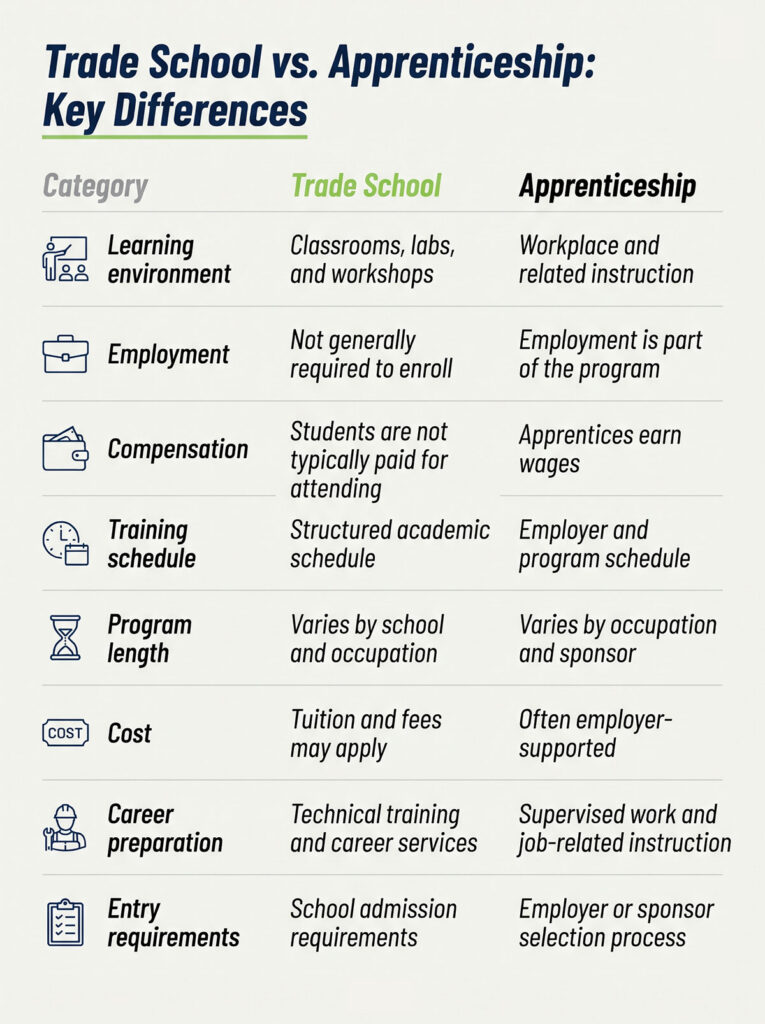
Neither pathway guarantees a particular career outcome.
The better option depends on how you prefer to learn, whether you need immediate employment, and what opportunities are available.
Why Choose Trade School?
Trade school offers several advantages for people who want a structured introduction to a technical career.
1. Build Skills Before Entering the Workforce
Not everyone has experience repairing engines, working with electrical systems, or operating welding equipment.
Trade school allows students to begin learning these skills in an instructional environment.
Students can practice procedures, ask questions, make corrections, and gradually develop confidence under instructor supervision.
This can be particularly valuable for someone entering an unfamiliar industry.
2. Learn Multiple Skills and Systems
An apprenticeship often focuses on the work performed by a particular employer.
Trade school programs may introduce students to a broader range of equipment, systems, and procedures within their chosen field.
For example, automotive training may include engines, brakes, electrical systems, diagnostics, and other vehicle components.
Welding students may learn several welding processes rather than concentrating on one application.
The breadth of training depends on the individual program.
3. Follow a Defined Training Schedule
Trade schools generally establish a curriculum and schedule before students begin.
That structure can help students understand what they will learn and when they may complete their program.
For students who recently graduated from high school, maintaining a regular learning schedule may also help preserve educational momentum.
Rather than waiting for a particular apprenticeship opening, students can explore available program start dates and admission requirements.
4. Receive Career Preparation and Support
Many career-focused schools provide assistance beyond technical instruction.
This may include resume preparation, interview practice, employer networking, and job placement assistance.
At Jones Technical Institute (J-Tech), Career Services helps students prepare for employment through career guidance, workplace skills instruction, and job-search support.
Employment is not guaranteed, but students have access to resources designed to support their transition into the workforce.
Why Choose an Apprenticeship?
Apprenticeships also offer meaningful advantages.
The most obvious is earning wages while learning.
Registered Apprenticeships provide paid employment, allowing participants to develop skills while receiving compensation.
Apprentices also gain direct workplace experience under experienced mentors.
This can be especially appealing to someone who already knows the occupation they want to pursue and has access to a suitable apprenticeship opportunity.
However, applicants should understand the requirements before committing.
Apprenticeships may involve competitive selection, specific work schedules, related instruction, and commitments that extend over several years.
Not every occupation offers the same opportunities.
Which Path Is Faster?
When comparing trade school vs. apprenticeship, training length is often an important consideration.
There is no universal answer.
Some trade school programs take only a few weeks or months. Others require a year or longer.
Apprenticeships also vary considerably depending on the occupation, employer, and training requirements.
At J-Tech, Automotive, Diesel, HVAC-R, Marine & RV, and Welding & Fabrication programs can be completed in as soon as 21 months. Commercial Truck Driving training can be completed in approximately four to eight weeks.
Students should compare the actual requirements of specific programs rather than assuming one pathway is always faster.
They should also consider when they can begin training.
Waiting for an apprenticeship opening may affect the timeline just as much as the program’s duration.
Can You Work While Attending Trade School?
Yes, depending on the program and your schedule.
This is an important consideration for people who need income while developing new skills.
Several J-Tech technical programs use a 2½-day weekly class schedule. That format may allow students to maintain employment while attending school.
Work availability and individual schedules will vary.
Unlike an apprenticeship, outside employment is not automatically part of the training program.
However, the flexibility to combine work and education can make trade school a practical option for students who cannot afford to stop earning money entirely.
What About Tuition and Financial Aid?
Cost is another important factor in the trade school vs. apprenticeship decision.
Registered Apprenticeships generally provide paid employment and related instruction supported through the program.
Trade schools may charge tuition, fees, and expenses for tools, supplies, or equipment.
However, financial assistance may be available.
Eligible students at qualifying institutions may have access to federal financial aid, scholarships, grants, or other assistance.
At J-Tech, financial aid and scholarships are available to those who qualify.
Before deciding, compare total education expenses, available assistance, expected training length, and the financial requirements of each pathway.
Do not base the decision solely on whether one option provides a paycheck immediately.
How J-Tech Prepares Students for Skilled Trades
J-Tech offers hands-on career training in Jacksonville, Florida, across several technical fields.
Students can explore programs in:
- Automotive Technology
- Diesel Technology
- HVAC-R
- Marine & RV Technology
- Welding & Fabrication Technology
- Network Administration and Security
- Commercial Truck Driving
Training combines classroom instruction with practical experience using equipment and tools relevant to each program.
J-Tech also maintains relationships with industry employers through Program Advisory Committees, on-campus recruiting, and career services.
These connections help students understand workplace expectations while preparing for entry-level opportunities.
For someone who wants to build technical skills before pursuing employment in a new field, this structured approach may be a good fit.
Which Training Path Is Right for You?
The best way to decide between trade school vs. apprenticeship is to consider your individual situation.
Ask yourself:
- Do I already know which occupation I want?
- Is an apprenticeship available in my area?
- Would I benefit from structured classroom and lab instruction?
- Do I need to earn wages immediately?
- How long will each training option take?
- What are the total costs?
- What credentials or qualifications will I receive?
- What career support is available?
There’s no single answer that works for everyone.
The important thing is to choose a realistic path and begin taking steps toward your goals.
Start Building Your Future at J-Tech
Choosing between trade school and an apprenticeship is an important decision, but it does not have to delay your future.
If you want structured, hands-on technical training, explore the programs available at J-Tech.
You can tour our Jacksonville campus, meet with Admissions, learn about training schedules, and discuss financial aid options.
The first step is finding the right path. The next is getting started.
Learn About J-Tech Career Services
Frequently Asked Questions
Is trade school better than an apprenticeship?
Neither is automatically better. Trade school offers structured technical education, while apprenticeships combine paid employment with supervised training. The right option depends on your occupation, finances, learning preferences, and available opportunities.
Do apprenticeships pay you while you learn?
Yes. Registered Apprenticeships include paid employment. Apprentices receive wages while gaining supervised work experience and completing related instruction.
Can you attend trade school without experience?
Yes. Many trade school programs are designed for beginners. Students can develop foundational knowledge and practical skills through classroom instruction and hands-on training.
Can trade school lead to an apprenticeship?
Potentially. Some apprenticeship sponsors recognize relevant prior education or training, although credit and eligibility vary by program. Completing trade school does not guarantee acceptance into an apprenticeship.
Does J-Tech offer job placement assistance?
Yes. J-Tech provides career guidance, resume development, interview preparation, employer networking, and job placement assistance. Employment is not guaranteed.
How do I decide between trade school and an apprenticeship?
Compare the occupation, training length, costs, availability, schedule, credentials, and employment requirements. Visiting a trade school and speaking with apprenticeship sponsors can help you understand which pathway fits your goals.